Hello Readers!
Recently, I've been reading and learning more about several game types for MTG, like the Grand Melee, Emperor, and EDH. In my past years of playing the game, almost a decade and a half ago, I had never heard of such things and just played the traditional 60 card deck casual game. Having come back into the playing MTG last Christmas, I've slowly become more and more interested with such concepts and now the idea of creating my own game type.
Over the last few weeks, I think I may have come up with something, but I wanted to pass it by the community for some thoughts on it. So, with that said, ladies and gentlemen, I present to you a possibly new game type called....
"Duel" Wield (Kind of punny, I know. The title is tentative and subject to change.)
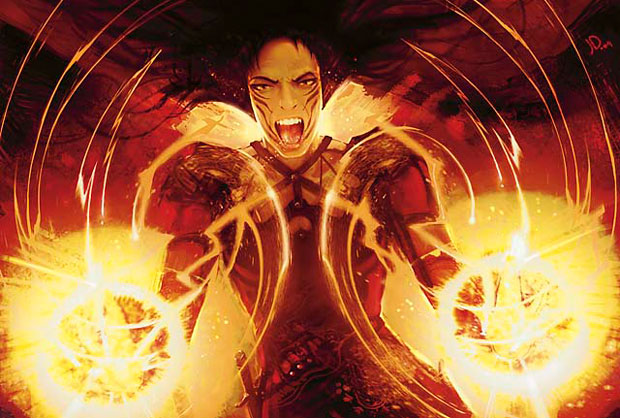 |
| I'm ambidextrous?! HOLY SHIT! |
The idea of the game type came to me after hearing a friend of mine call his deck "a weapon". As soon as I heard that, I started to wonder, if you fight with one weapon, why not two? This question continued to ring in my mind as I began to notice forms of dual wielding in other media: Movies I watched (Equilibrium for example) , video games I played (Skyrim), and even in reading about fictional and historical warriors (like Miyamoto Musashi). So, if people can use two weapons at once, how do you use two decks at once and make it competitive while fair? Here is a list of rules I've compiled thus far for this game type...
 |
| This is important, there will be a quiz later... Maybe... |
"Duel" Wield - Rules (as of 8/18/12)
***All of these are subject to change, and may, depending on feedback and suggestions. This listing will be updated when that occurs.***
1) This game type is meant for 1v1 duels ideally, but can be played as a 2v2 as well (Anything higher or at an odd number might become confusing or lopsided.).
2) Each player uses two 40 card count decks and both decks can NOT be the exact same color(s) (Example - You can play a Mono Red deck with a R/G deck, but you cannot play 2 Mono Red decks or 2 R/G decks.).
3) Both decks must have different sleeves from each other or at least one can be sleeved while the other isn't, they just need to be able to be told apart from one another.
4) Starting life total for each player is 30.
5) Steps and phases within a turn are the same as it is in other more popular game types (IE- Upkeep, 1st Main, Combat, 2nd Main, End Step).
6) During your draw phase, you may draw one card from either deck, not both. During your end step, you may draw a card from the deck you did not choose.
7) Maximum hand size is 10. If your hand exceeds this amount, you must discard down to 10 by the end of your turn.
8) During your turn, you may play two lands instead of one if they are both not from the same deck and not the same land (Example - If you are playing a U/B deck and a Mono White deck, you may play either an island or swamp from the first deck and a plains from the second deck, if you have one from both in hand during your turn. If you are playing a R/B deck with a G/B deck, you cannot play two swamps at the same time, even if they are from both decks.).
9) Each player may use spells, abilities, and permanents from either deck to help and cast from the other. (Examples - Player uses Overrun from a Mono Green deck on human tokens from a Mono White deck. Player used Drowned Catacombs from a U/B deck to cast out Delver of Secrets from a Mono Blue deck.).
10) Spells and abilities that force or allow a player to draw, mill, or search your library may target either library of said player. Any set amount of cards mentioned in the spell or ability may be split between said player's decks (Example - A player casts Ponder. He/she chooses to look at the top two cards from one deck, and one from the other deck, then draws from either of the decks.).
11) A player does not lose the game if he/she can no longer draw from one deck. So long as one deck has a library to draw from, that player remains in the game. That player may then choose to draw an additional card from their remaining deck during their end step since their other deck is no more. (Example - A player was using a G/U deck and a Mono Black deck, but had his/her Mono Black deck milled to nothing. He/she may then choose to draw again from their G/U deck during their end step.). The player may then also play two lands a turn from the same deck, even if they are the same type. This situational rule is to help the players stay competitive since they are at a disadvantage. This can also work as an advantage if utilized correctly.
12) Sideboards are optional, but if you choose to use it, the limit is 10 cards per deck.
So how exactly would a deck pair look and work with this format? Here are two examples to show how this could work...
http://www.mtgdeckbuilder.net/Decks/ViewDeck/225539
and
http://www.mtgdeckbuilder.net/Decks/ViewDeck/225560
Looking at these two decks, you can kind of see how these two would work together. Granted, it may not be the greatest combination, but you can see the point of how decks could be made for this format. I ask you now to consider what you will of this format and try playing with it a bit. Please let me know what you think. I am open to any feedback, suggestions, and thoughts about this. I honestly don't know how far I will take it if it picks up, I just wanted to share this idea with you all and see if this would fly or die.
 |
| Come at me bro! |


